Martial Arts Glossary & Knowledge Base — Wing Chun & Jiu-Jitsu Melbourne
Every martial art comes with its own terminology and structure. Learning these can make a huge difference in how quickly you settle into training. Our team at Wing Chun & Jiu-Jitsu Melbourne breaks down the key terms used in Wing Chun, Brazilian Jiu-Jitsu (BJJ), and children’s martial arts, based on practical, real-world instruction.
The goal of this guide is to help prospective students and families build confidence and clarity in the two martial arts we offer.
Martial Arts
Martial arts encompasses a broad range of traditional and modern combat systems designed to improve self-defence skills, discipline, fitness, coordination, and mental resilience. In Melbourne, many martial arts schools offer instruction in styles such as karate, taekwondo, Wing Chun, and Brazilian Jiu-Jitsu. The right program should focus on technique development, safe practice, and the gradual introduction of sparring or live drills.
Do I need to be fit to start martial arts?
No. Classes are designed to build fitness over time. Beginners of all fitness levels are welcome.
Can adults and children train together?
In most schools, adults and children train in separate classes tailored to their needs, learning styles, and developmental stages.
How often should I train?
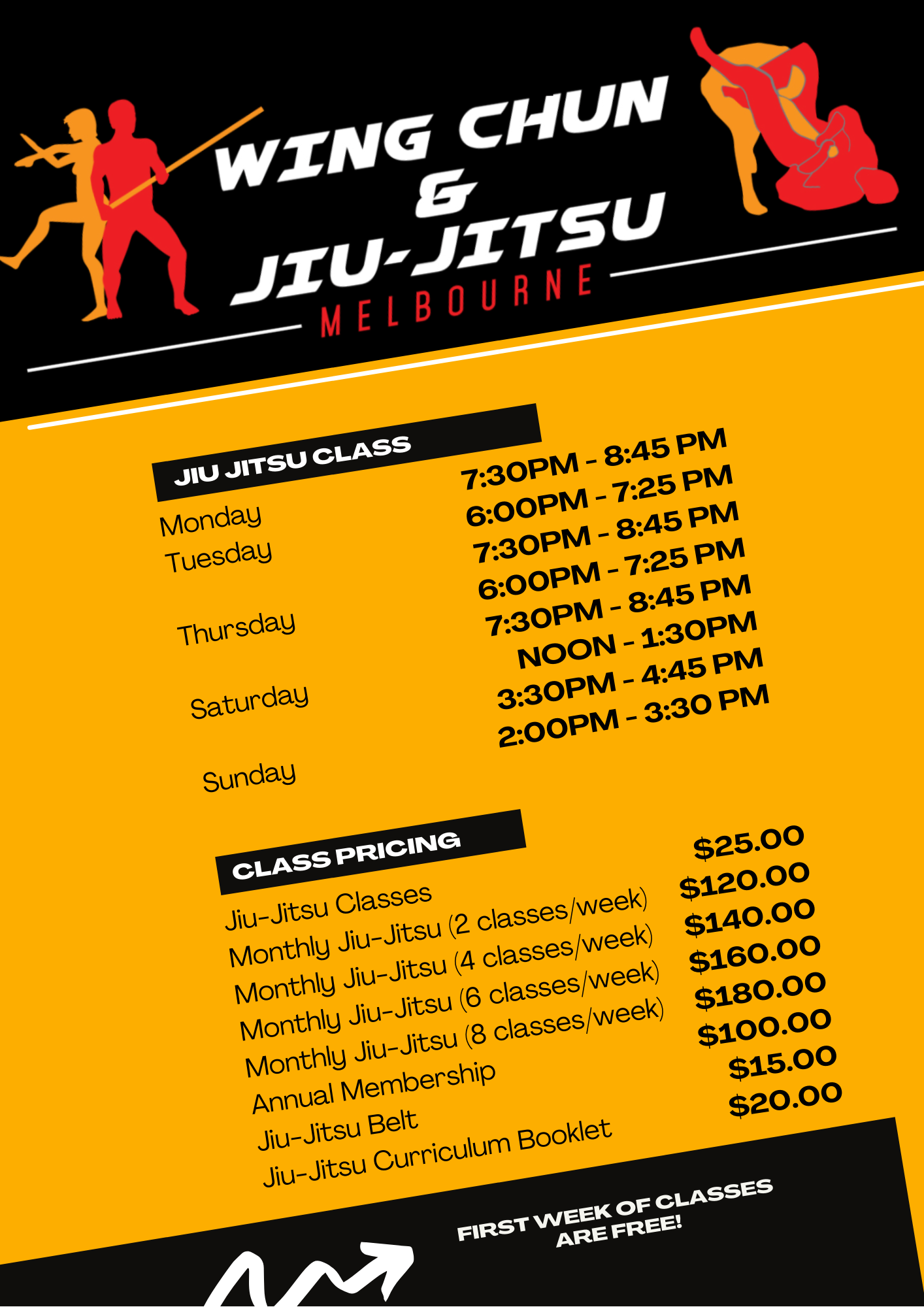
Most students start with 2 classes per week and build from there.
Wing Chun
Wing Chun is a southern Chinese martial art known for its close-range striking, economy of movement, and straight-line attacks. It places emphasis on structure, centreline control, and reflex development through partner drills like Chi Sau (sticking hands). In Melbourne, Wing Chun is taught as a practical self-defence system rather than a sport, with a focus on real-world application.
Is Wing Chun effective for smaller individuals?
Yes. Wing Chun was designed to neutralise size and strength advantages through technique and structure.
Are weapons taught in Wing Chun?
Traditional Wing Chun includes the long pole and butterfly swords at advanced levels. Most beginner classes focus on empty-hand techniques.
Is sparring part of Wing Chun training?
Yes, but sparring is introduced gradually. Early focus is on partner drills and controlled application.
Brazilian Jiu-Jitsu
Brazilian Jiu-Jitsu (BJJ) is a grappling-based martial art focused on ground fighting, positional control, and submissions. It is widely practiced as both a self-defence system and competitive sport. BJJ schools in Melbourne often follow a belt progression system and emphasise live sparring (rolling) as a key part of training.
How does adult belt promotion work in Brazilian Jiu-Jitsu in Melbourne?
In Brazilian Jiu-Jitsu (BJJ), adult students progress through the belts in the following order — white, blue, purple, brown, and black. Promotions are based on a combination of time spent training, technical ability, rolling (sparring) performance, and overall attitude on and off the mat. In Melbourne, most schools follow the standards set by the International Brazilian Jiu-Jitsu Federation (IBJJF), though exact promotion criteria may vary between academies.
Students typically receive stripes on their belt as markers of progress before advancing to the next colour. There are no formalised grading exams at most Melbourne academies. Instead, instructors observe progress during regular classes and may award belts during dedicated promotion events or seminars.
Time between belts can vary significantly. For example, progressing from blue to purple may take 2 to 4 years depending on consistency, effort, and school policies. The process is designed to keep standards high and make promotions meaningful.
Is Brazilian Jiu-Jitsu safe for beginners?
Yes. Reputable schools introduce techniques progressively and pair new students with experienced partners.
Do I need a gi to train?
Most schools offer both gi and no-gi classes. Beginners usually start with a gi, which helps with learning grips and control.
Is BJJ effective for self-defence?
Absolutely. BJJ equips students with strategies to control or neutralise threats, especially in close-contact situations.
Children’s Martial Arts Melbourne
Children’s martial arts classes are designed to develop focus, discipline, fitness, and confidence in a supportive environment. Across Melbourne, programs often combine age-appropriate self-defence skills with fun, structured training sessions. Progression is measured through class participation, technique development, and in some cases, belt ranking.
What age can children start martial arts?
Many schools accept children from age 4 and up, depending on class structure and child readiness.
Will martial arts in melbourne make my child aggressive?
No. Properly taught martial arts promote respect, restraint, and emotional control.
Can my child try a class before enrolling?
Yes. Most schools offer trial classes so children and parents can see if it’s a good fit.
Children’s Brazilian Jiu-Jitsu Melbourne
Children’s BJJ programs in Melbourne introduce grappling skills in a safe, structured setting. Emphasis is placed on body awareness, cooperation, and learning how to fall, roll, and move with control. Classes often include games, drills, and modified sparring suited to children’s age and size.
How are children promoted through the BJJ belt system in Melbourne?
In Brazilian Jiu-Jitsu (BJJ), children follow a separate belt system to adults, designed to recognise age-based development and encourage progress through consistent effort and learning.
In Melbourne, most schools use the internationally recognised children’s belts — white, grey, yellow, orange, and green, often with intermediate belts like grey-white or yellow-black. These belts are awarded based on a child’s attendance, understanding of techniques, attitude in class, and respect for others rather than winning matches or demonstrating aggression.
Children also earn stripes on their belts as milestones between promotions. Some schools conduct formal grading assessments, while others promote children during class or at special events. Age and maturity play a role in determining when a student can move up, and students typically transition to the adult belt system around age 16.
The goal in Melbourne’s BJJ community is to keep promotions meaningful, age-appropriate, and motivating, thus ensuring children grow in both skill and confidence.
Is BJJ appropriate for shy or introverted children?
Yes. BJJ helps build confidence through physical achievement and one-on-one interaction.
Do kids need to compete in tournaments?
No. Competition is optional. Many children train for fitness, confidence, and fun.
What should children wear to class?
Most children start in a clean gi and belt. Some classes offer no-gi days with rash guards and shorts.
General Martial Arts Glossary
Affiliation — The official connection between a school and a broader martial arts organisation or lineage.
Base — A stable body position used to resist being pushed or pulled off balance.
Belt Promotions — Events or assessments where children demonstrate progress and earn new belt levels.
Belt System — A way to signify rank or skill level. Colours and progression vary by style.
Bong Sau — A deflective arm position used to redirect attacks off the centreline.
Breakfall — A controlled way of falling to minimise injury, commonly practiced in BJJ and Judo.
Bullying Awareness — A common element of children’s martial arts that teaches how to identify, avoid, and deal with bullying.
Centerline Theory — A core concept in Wing Chun that prioritises control of the centre of the opponent’s body.
Chain Punches — Rapid, successive punches aimed at overwhelming an opponent and maintaining forward pressure.
Chi Sau (Sticking Hands) — A partner drill used to develop sensitivity, reflexes, and flow. Students learn to feel pressure and respond instinctively.
Controlled Sparring — Light, supervised grappling where children apply techniques with safety and respect.
Discipline — The ability to follow structure and training protocols. Core to all martial arts.
Dojo — A training hall or space where martial arts classes are held.
Forms (Kata or Taolu) — Prearranged sequences of movements that represent attack and defence patterns. Common in traditional martial arts like Wing Chun.
Gi — A traditional uniform worn in many martial arts disciplines, particularly BJJ. Usually consists of pants, a jacket, and a belt.
Guard — A ground position where one practitioner uses their legs to control or defend against an opponent from their back.
Kyu / Dan — Japanese terms for belt ranking systems. Kyu refers to lower ranks, Dan to black belt levels.
Lap Sau — A pulling or trapping technique used to control or off-balance an opponent.
Lineage — Refers to the instructor’s martial arts background and who they were taught by — important for understanding how a style is passed down.
Mat Chats — Short, structured conversations during class that cover topics like respect, focus, and self-discipline.
Motor Skill Development — Physical drills designed to improve coordination, balance, and agility in young learners.
Mount — A dominant position where a practitioner sits on top of their opponent’s torso, offering strong control and submission options.
OSS — A phrase commonly used in BJJ and other arts to signal respect, acknowledgment, or agreement.
Pass the Guard — A movement that allows a practitioner to transition from an opponent’s guard to a more dominant position.
Positive Reinforcement — Encouragement-based teaching style used to build self-esteem and classroom participation.
Positional Drills — Guided exercises to help children understand and maintain positions like guard, mount, and side control.
Reaping — A leg motion in grappling that hooks or pulls the opponent’s leg. Restricted in some beginner divisions.
Respect Bow — A short bow performed at the beginning or end of class, or before sparring, to show mutual respect.
Rolling — Live sparring in BJJ. Practitioners grapple in real time with varying levels of resistance.
Rolling Etiquette — Unwritten rules of conduct during sparring. Includes tapping, controlled intensity, and hygiene.
Self-Defence — Techniques and strategies used to protect oneself from harm, often taught alongside sport-specific drills.
Shrimping — A movement drill used to create space and escape from underneath an opponent.
Sil Lim Tao — The first and most fundamental form in Wing Chun. It teaches structure, positioning, and foundational techniques.
Sparring — A form of controlled combat practice, often supervised, where students apply techniques in real time against a resisting partner.
Submission — A technique that forces an opponent to surrender, such as a choke or joint lock.
Tap Early, Tap Often — A key safety rule in BJJ that reminds students to submit early to prevent injury.
Tap Out — A physical or verbal signal indicating submission during rolling or drilling.
Your Local Wing Chun & Jiu-Jitsu School In Melbourne
By sharing both professional explanations and student-friendly FAQs, our team at Wing Chun & Jiu-Jitsu Melbourne aims to help new and prospective martial arts students better understand what to expect when training in these two martial arts. This resource page is not intended to replace speaking with a qualified instructor or experiencing a class firsthand.
Still have questions? We’re here to help. Contact Wing Chun & Jiu-Jitsu Melbourne today for professional guidance. We are located at 13/10 Mirra Ct, Bundoora VIC 3083, Australia. Our students travel from across Melbourne including Bundoora, Preston, Eltham, Epping, Thornbury, Greensborough, Coburg, Templestowe, Reservoir, Thomastown and other surrounding suburbs.
Find Wing Chun & Jiu-Jitsu Melbourne: 13/10 Mirra Court, Bundoora 3083.
Beginners Welcome!
One Week FREE Trial!
Call Declan 0435 012 390.